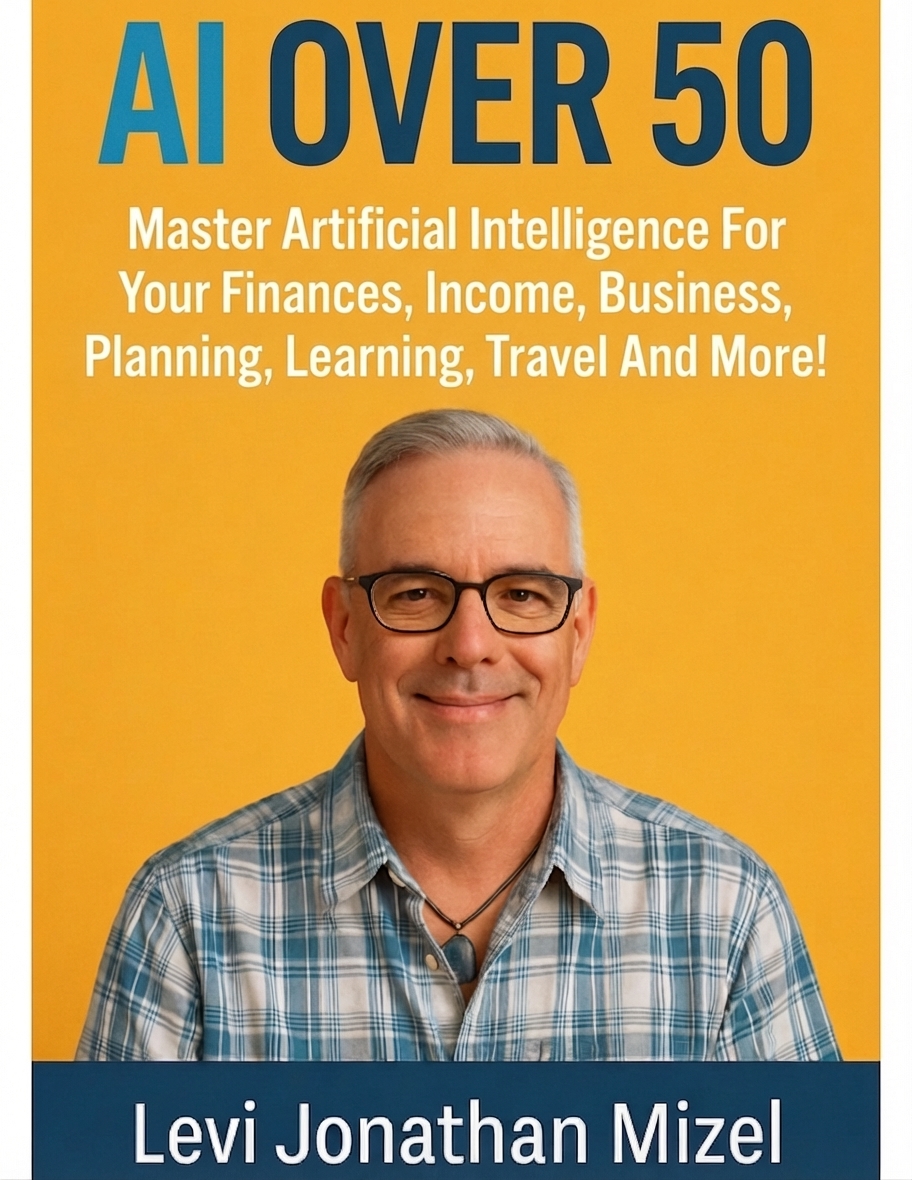
Eat This Book
A book about using AI ought to survive being fed to one. This page is about what happens when you stop treating books as things to finish and start treating them as material. Starting with this one, then every other book you own.
Start with this one
AI Over 50 teaches a way to get real work out of AI without becoming a technician. The fastest way to prove the method works is to point it at the book itself.
Feed it the whole file. Ask which three ideas actually apply to your week, then tell it to build the thing rather than describe it. A book about using AI that can't survive being run through AI wasn't worth your evening.
That's the specific case. The general one is more interesting.
A Book Isn't A Book Anymore
That works on one book. The method doesn't care which book, though, and that's the part worth sitting with.
Paper made books linear. One sequence, chosen by the author, shipped to every reader regardless of what any of them already knew. We got used to calling that structure. Mostly it was a manufacturing constraint, because you can't bind the same pages in twelve different orders. Chapter 1 went first because something had to.
That constraint is gone. Most people haven't noticed, because a book still looks like a book. Here's what one actually is now.
1A book is an agent.
Hand a book to an AI along with instructions for how to use it and you no longer have a document. You have something that acts. Claude's Skills format, and the book-to-skill converters floating around GitHub, will turn a book into a callable capability: not "search this text" but "apply this book to what I'm doing right now."
The book stops being a thing you finished in 2019 and becomes a standing advisor you consult on a Tuesday about one specific problem. Once it's an agent, other things can call it. A book can end up as infrastructure inside somebody else's workflow.
2A book is a database that happens to have chapters.
The index at the back was the primitive version of this. It was an admission that you'd want random access, limited to whatever terms the indexer happened to think of. Now the entire book is the index, and you can ask for things no indexer would ever list:
- Every claim the author makes without supporting evidence
- Every assumption they never examine, because it was obvious to them and isn't to you
- Which claims have rotted. Published 2019, so what's been superseded since?
- What the book never covers, plus the questions it raises and then quietly drops
That last one is the valuable one. Gaps are invisible when you read start to finish. They're obvious the moment you interrogate.
3A book is an engine that outputs.
Same source material, many different shapes coming out the other end:
- A curriculum sequenced to your gaps rather than the author's chapter order
- A decision checklist: the book's implicit rules made explicit, so you can run a real decision through them
- Articles, briefings, or a chat you can argue with
- Business ideas that follow from the book's own logic rather than your mood that morning
- Worksheets, quizzes, a one-page brief for a colleague who will never read the thing
- Voice separated from content, the author's cadence applied to your material. This one gets ethically murky quickly, so know where your line sits before you start.
4A book is a sparring partner.
The most underused move by a distance. Feed the book your actual plan and tell it to attack, using the book's framework rather than generic AI encouragement.
- Critique my plan the way this author would, and don't be nice about it
- Steelman this book's central thesis, then take it apart
- What would have to be true for this book to be wrong? Books almost never state their own falsification conditions, and extracting them tells you how seriously to take the rest
- This book made predictions. Score them against what actually happened.
A book that can't survive cross-examination by its own reader was never worth the shelf space.
5Books stopped competing and started composing.
This is the one that changes what your whole shelf is worth. Books used to fight each other over the same scarce resource, which was your reading hours. Only one of them could win an evening. Now they combine:
- Put two books that disagree in the same room. Where exactly do they contradict each other, and on whose evidence? That's an afternoon now. It used to be a dissertation.
- Use one book as a lens on an unrelated domain. Run a negotiation book over your hiring process, or a book about restaurant kitchens over your development team.
- Ask forty books in a genre what they genuinely agree on. The consensus is usually far thinner than the genre pretends, which is worth knowing before you buy the forty-first.
Your shelf used to be a list of things you'd read. It's a corpus.
Different from building a brain out of your own material, which is its own discipline and covered elsewhere. This is about books you didn't write: the ones already on your shelf, doing nothing.
Where this doesn't work
Worth being straight about the limits, since the feed-everything-to-AI crowd generally isn't:
- It works on books that encode method, fact, or framework. It does not work on novels. You cannot put a novel through the woodchipper and catch the novel, because the experience was the entire point.
- Garbage in, confident garbage out. Ingesting a bad book hands you a fluent, tireless, wrong advisor. A book being wrong doesn't announce itself, and the AI won't flag it for you.
- Books you own. Your library, your purchases, your notes. Not scraping and republishing somebody else's work.
- The judgment stays yours. AI will apply any book to any problem with exactly the same enthusiasm whether it fits or not. Knowing which of a book's ideas actually belongs in your life is the part that hasn't been automated, and it's the part now worth the most.
The reading was never the point.
Reading was just the only extraction method available.
The book this came from
AI Over 50: Your Experience Is the Advantage. Written to be eaten.
Get the book See BrainDen